
West Bengal Chief Minister Mamata Banerjee is set to hold a dharna in Kolkata against alleged arbitrary deletions in the state's electoral rolls, marking a return to her roots as a street fighter and signalling a key political battle ahead of Assembly elections.

Indian car buyers care more about affordability than technology, keeping ICE vehicles dominant while hybrids emerge as the preferred transition option and EVs struggle in the mass market.

Passenger vehicle sales in India kicked off on a flat note in new fiscal 2024-25 with 3.38 lakh units sold in April, impacted by high base effect and muted demand due to the ongoing general elections. Dispatches of passenger vehicles from manufacturers to dealers were at 338,341 units in April 2024 as compared to 332,468 units in the same month last year, a growth of 1.77 per cent with major players Maruti Suzuki India, Hyundai and Tata Motors reporting marginal growth in their domestic wholesales.

Tata Motors recorded its highest-ever monthly retail sales in November on the back of robust demand for its sports utility vehicles amid the festive period, according to a top company official. In an interaction with PTI, Tata Motors passenger vehicles managing director Shailesh Chandra said the automaker retailed around 53,000 units in November, which was 8 per cent higher as compared to October this year and 30 per cent up as compared to sales in November 2022. The company also witnessed strong sales performance in the 47 days long festive period this year with registrations of around 79,374 units, up 18 per cent over the same period of last year.

The New Tata Punch is a fantastic deal for first-time buyers. You get SUV capabilities and premium features like Clima Touch Automatic Temperature Control, an integrated air purifier, and rain-sensing wipers, says Rajesh Karkera.

'Favourable product mix, sales recovery, and cost saving initiatives are expected to support margins going ahead while focus on debt reduction (target of debt free by FY24) will aid balance sheet strength'
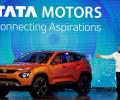
Tata Motors on Monday said the voluntary delisting of its American Depositary Shares, representing ordinary shares, from the New York Stock Exchange will become effective close of trading on January 23, 2023. After Monday, there will be no over-the-counter market trading of the American Depositary Shares (ADSs) in the US due to regulatory restrictions under the Indian law, Tata Motors said in a regulatory filing.

In a major victory for Tatas, an arbitral tribunal has awarded Tata Motors a compensation of over Rs 766 crore for the losses incurred because of protests by Trinamool Congress that stalled its small car project at Singur in West Bengal. The tribunal asked the West Bengal government to pay Tata Motors the compensation, along with interest, according to a stock exchange filing by the Mumbai-based auto major on Monday. The company stated that the arbitral tribunal has asked the West Bengal Industrial Development Corp (WBIDC) to pay the company Rs 766 crore compensation, in connection with losses incurred on its manufacturing site in Singur.

Tata Motors, the market leader in electric four-wheeler space, has sought incentives for its Tiago EV under the government's production-linked incentive (PLI) scheme, group chief financial officer P B Balaji said on Tuesday. The Mumbai-headquartered firm has applied for all variants of the Tiago, which recently hit a sales milestone of 10,000 units. "The Automotive Research Association of India certification is done.

After clocking losses for seven straight quarters, Tata Motors on Wednesday posted a consolidated net profit of Rs 3,043 crore in the third quarter (Q3) of 2022-23. This came on the back of a strong order book, better semiconductor chip supply, tempered commodity prices, and a better product mix. "We remain cautiously optimistic about the demand situation, notwithstanding the global uncertainty.
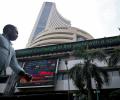
From the Sensex pack, Asian Paints, ICICI Bank, PowerGrid, Larsen & Toubro, Bajaj Finserv, Bharti Airtel, Sun Pharmaceuticals, Maruti Suzuki India, Axis Bank, UltraTech Cement and HCL Technologies were the only gainers. On the other hand, Eternal, Tata Motors' commercial vehicles arm, Mahindra & Mahindra, Tata Steel, Bharat Electronics Ltd, Tata Motors Passenger Vehicles, Trent, Tata Consultancy Services, Hindustan Unilever, and Infosys were among the laggards.

Tata Motors on Monday said it has bagged an order for supply of 10,000 XPRES-T EV units from BluSmart Electric Mobility. The deployment of 10,000 units makes this the biggest ever EV fleet order in India, the auto major said in a statement. With deliveries starting soon, these vehicles are an addition to the 3,500 XPRES-T EV order, which was signed by both the companies in October last year, and will be used across the country for commuters, in turn helping minimise the carbon footprint.

Government schemes such as the PM E-Drive initiative, with allocations of around Rs 2,000 crore for charging points deployment, are helping accelerate rollout
Tata Motors, India's largest electric passenger vehicle manufacturer, has signed an agreement with ride-hailing company Uber to supply 25,000 electric vehicles (EVs), the company said. The agreement is the largest EV commitment between an automotive manufacturer and a ride-sharing platform in India. Under the agreement, Uber will deploy Tata Motors' XPRES-T EVs by partnering fleet operators in Delhi National Capital Region, Mumbai, Kolkata, Chennai, Hyderabad, Bengaluru, and Ahmedabad.

Homegrown auto major Tata Motors on Monday said it will launch its mini SUV Punch in the ongoing festive season. Punch is based on the H2X concept, which Tata Motors had showcased at the Auto Expo 2020. It will be positioned below the company's compact SUV Nexon and is expected to hit the market around Diwali this year.

Don't let the subcompact label fool you, the Tata Punch is a real SUV at heart, warns Rajesh Karkera.

Homegrown auto major Tata Motors on Tuesday said it has received 98 patents last year under its accelerated drive for engineering excellence and innovation. These patents predominantly relate to the megatrend of CESS (connected, electrified, sustainable and safe) automobiles, the company said in a statement. The patents also encompass an eclectic mix of improvements in automotive electronics, noise vibration and harshness, conventional and advanced powertrain systems, and crash safety under various categories of industrial designs, copyrights and notarisations, the statement added.

With demand continuing to be strong post the festive season, leading automakers, Maruti Suzuki, Tata Motors and Mahindra & Mahindra, saw robust growth in sales in November as compared to the same month last year. Maruti Suzuki India reported the best-ever total sales, including exports, last month at 229,021 units, a year-on-year growth of 26 per cent as compared to November last year.

India's electric passenger vehicle (ePV) market has expanded sharply over the past five years, with registrations rising from just 3,252 units in 2020 to about 170,000 in 2025. Throughout this scale-up, southern states have remained the bedrock of adoption, consistently contributing around one-third of national electric vehicle (EV) registrations - emphasising the region's role as the structural backbone of India's EV transition.

CURVV, currently in its production-ready avatar, will first be made available as an electric vehicle, to be followed by its internal combustion engine counterpart.

S&P Global Ratings has upgraded its long-term ratings on Tata Motors to speculative grade 'BB' with stable outlook on earnings improvements and potential deleveraging. The ratings agency had earlier placed Tata Motors in 'BB-'. As per S&P ratings, a BB grade is less vulnerable in the near-term but faces major ongoing uncertainties to adverse business, financial and economic conditions.
Tata Motors on Monday said its subsidiary and Ford India have inked a pact with the Gujarat government to acquire FIPL's Sanand vehicle manufacturing plant. Tata Passenger Electric Mobility Ltd (TPEML) -- a subsidiary of Tata Motors -- and Ford India Pvt Ltd (FIPL) have today signed a memorandum of understanding (MOU) with the Gujarat government for the potential acquisition of FIPL's Sanand vehicle manufacturing facility, including land, buildings, vehicle manufacturing plant, machinery and equipment, Tata Motors said in a regulatory filing. The MoU also includes the transfer of all eligible employees of FIPL Sanand's vehicle manufacturing operations, subject to the signing of definitive agreements and receipt of relevant approvals, it added.

From its lows in December, the stock of Tata Motors is up about 15 per cent. The gains came on the back of better than expected December volumes in its UK-based subsidiary Jaguar Land Rover (JLR). This coupled with gradual recovery in the global passenger vehicle demand, improving profitability due to product mix and lower commodity costs are expected to be key positives for the company.

Companies with "gas guzzlers" are trying to set up the wrong narrative against small cars getting relaxation in the proposed corporate average fuel efficiency (CAFE-III) norms on the basis of weight, Maruti Suzuki senior executive officer corporate affairs Rahul Bharti said on Monday, bringing to the fore deep division among carmakers regarding the upcoming rules.

Recently, TPEM's first born electric concept, Avinya broke cover. The model promises a minimum range of 500 kilometres and advanced technology features, aimed at buyers in India and outside. TPEM, the newly formed entity may also consider a separate dedicated sales channel for the EVs with a distinctive corporate identity once the volumes reach a critical mass and throughput is large enough for the dealers to be profitable, said Chandra. Elaborating further on the hiring strategy he said, "We will hire from everywhere-wherever the talent of the required competency is available."
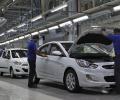
Top carmakers led by Maruti Suzuki, Mahindra & Mahindra, Tata Motors Passenger Vehicles and Kia India on Saturday reported record sales in the domestic market riding on festive demand boosted by GST rate cut. Other manufacturers such as Skoda Auto India and Toyota Kirloskar Motor also posted impressive growth in sales in October.

Three additional vehicle makers and five more auto component makers will begin availing financial incentives under the production-linked incentive (PLI) scheme for the automobile sector from 2026-27 (FY27) onwards, Hanif Qureshi, additional secretary at the Ministry of Heavy Industries (MHI), said on Wednesday.

Usually, in the western view, corporate success is attributed to efficiency, organisational structure, and scale. R Gopalakrishnan and Harish Bhat argue that philosophy, culture, and the transmission of values are more important for sustaining growth and profitability of an enterprise over a period of time.

Tata Motors on Tuesday said it will increase prices of its passenger vehicles by an average of 0.9 per cent with effect from January 19, in order to partially offset the impact of rise in input costs. The Mumbai-based automaker sells various models like Tiago, Punch and Harrier, in the domestic market. Effective January 19, 2022, an average increase of 0.9 per cent will be implemented, depending on the variant and model, the automaker said in a statement.

Homegrown auto major Tata Motors announced its foray into Indonesia with the setting up a wholly-owned Jakarta-based subsidiary and plans to launch its products in 2013.

You know the Tata Sierra is a true icon when driving on the highways and hill climbs of Chandigarh, the car instantly drew all eyes to it.

Tata Safari - The Legend Lives!

Sustaining 8 per cent-plus growth rates is necessary if we are to reach high-income status by 2047, points out Amitabh Kant.

Prime Minister Narendra Modi on Sunday charged the Trinamool Congress government with 'playing with national security by protecting infiltrators' for vote-bank politics, and said ending the ruling party's 'maha jungle raj' was vital to restore law and order, development and investor confidence in the state.

Tata Motors is actively considering tapping into some of the export markets beyond South Asia, for its range of electric vehicles (EVs) as it sees an opportunity of selling affordable EVs in markets outside India. The export plans will coincide with the commercial launch of the Curvve - an electric SUV concept that broke cover on Wednesday, in two years from now, Shailesh Chandra, MD, Tata Motors PVs and Electric Mobility, told Business Standard. "We are actively thinking of the international markets and we would like to go with a portfolio of products. "We have identified a few markets and in a couple of years, we should commence the same," said Chandra.

From the Sensex firms, State Bank of India, Bajaj Finserv, Bajaj Finance, Maruti, HCL Tech, Larsen & Toubro, Mahindra & Mahindra and Infosys were among the major winners. However, Hindustan Unilever, Eternal, Tata Motors Passenger Vehicles, and Sun Pharma were among the laggards.
Tata Motors is looking to increase passenger vehicle prices from next month in order to make its model range compliant with stricter emission norms which kick in from April 1 next year, according to a top company official. In an interaction with PTI, Tata Motors Managing Director - Passenger Vehicle and Electric Vehicles Shailesh Chandra said the price revision would also offset the impact of commodity prices, which have remained high for the most part of the year. "The regulatory change will have its impact on the cost. Even the real impact of softening of commodity prices is only going to come from next quarter and we still have the residual impact of the commodity escalation that we have seen during the year," Chandra said.

Tata Motors is stripped off India's most valuable company tag.

Auto majors Maruti Suzuki, Tata Motors and Mahindra & Mahindra reported robust sales in September as reduced price tags owing to GST rationalisation led to record demand in the Navaratri period. The month also saw Tata Motors and Mahindra & Mahindra settling at number two and three positions, respectively in vehicle wholesales ahead of Hyundai Motor India.

Indian automakers are reviving legacy nameplates to leverage brand recall and stand out in a crowded market, as classic badges like Sierra, Safari, Baleno and Scorpio return to attract buyers.
